
 TopGK
TopGK Shop All



![The Legend of Zelda Link 1/6 Scale TOPGK Statue[R18] In Stock-MintBoy Studio - Photo 13 | TopGKStore](https://topgkstore.com/wp-content/uploads/2026/03/The-Legend-of-Zelda-Link-16-Scale-TOPGK-StatueR18-In-Stock-MintBoy-Studio-9-100x100.webp)
 By Source Type


Best-selling products, Buying Guide
When Guts Finally Stops — The Story Behind CE Studio’s “Leaning Against the Tree” Berserk Statue
Sep
CE Studio – Berserk Guts 1/4 Scale TOPGK Resin Statue
There are countless ways to portray Guts.
You can show him raising the Dragonslayer. You can freeze him in the middle of a brutal attack. You can surround him with monsters, flames, and destruction.
CE Studio chooses something quieter.
Guts is sitting.
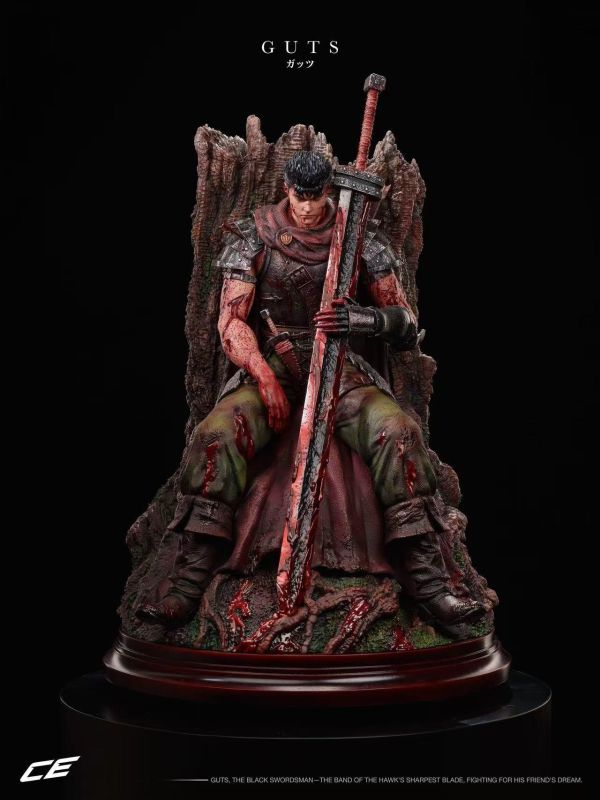
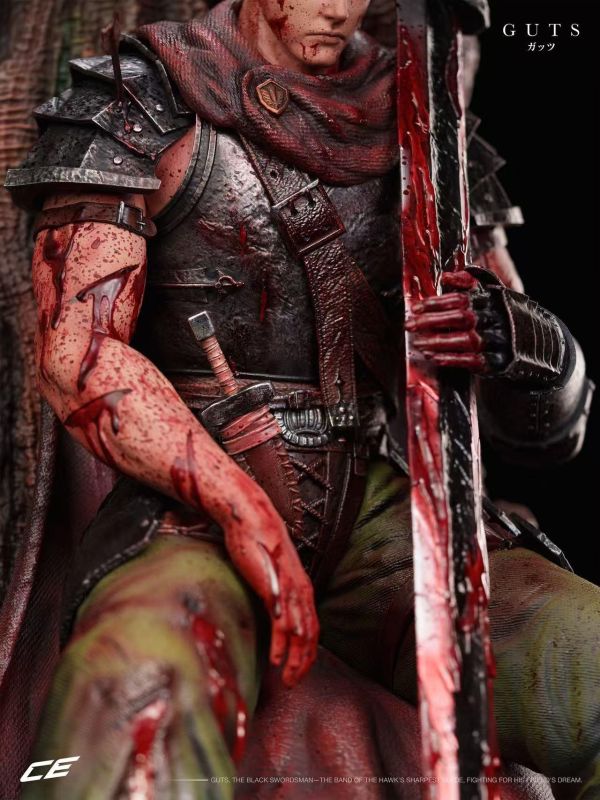
He is wounded. His armor is damaged. His body carries the marks of another brutal battle. His head hangs low, and the enormous Dragonslayer rests beside him.
Yet he has not let go.
That single detail changes the entire meaning of CE Studio’s Berserk Guts “Leaning Against the Tree” 1/4 Statue.
Instead of celebrating the Black Swordsman through another explosive combat pose, this statue focuses on what happens after the fighting stops. It captures exhaustion without surrender, pain without defeat, and a rare moment when one of manga’s most relentless characters is finally forced to rest.
For Berserk collectors, that makes this more than another Guts statue. It becomes a scene about survival.
The Guts We Rarely See
Guts is usually associated with movement.
The Dragonslayer swings. Armor crashes into monsters. Blood covers the battlefield. His expression hardens as another enemy approaches.
However, Berserk is also a story about the physical and emotional cost of constantly fighting.
That is where this statue finds its identity.
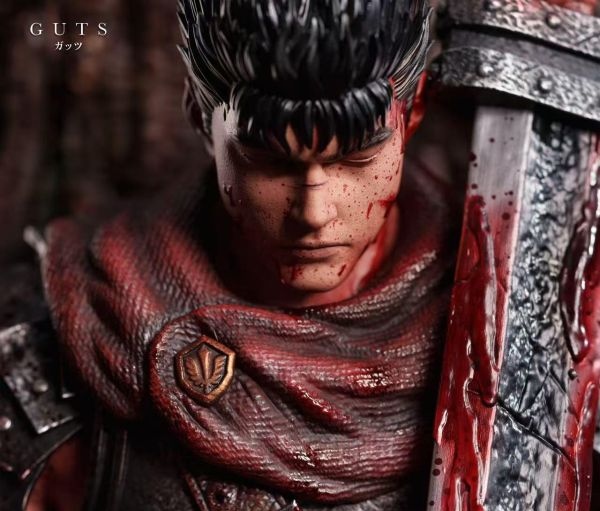
Guts is not presented as an unstoppable warrior at the peak of his strength. Instead, CE Studio shows the aftermath of violence. His body appears heavy against the tree, while his posture communicates fatigue from head to toe.
His shoulders drop.
His head lowers.
His hair falls across his face.
His armor carries scars from battle.
Everything about the pose suggests that he has reached the point where continuing forward requires a moment of recovery.
And yet, the Dragonslayer remains close.
That contrast is the heart of the piece.
Why a Resting Pose Can Say More Than an Action Pose
A dynamic combat statue immediately tells you what the character is doing.
A resting statue can tell you what the character has been through.
That distinction is particularly important with Guts.
If CE Studio had shown him charging toward an enemy, the focus would naturally fall on strength and aggression. Instead, the studio creates a quieter scene and allows the collector to imagine what happened immediately before this moment.
Who did Guts fight?
How badly was he injured?
How long has he been sitting there?
Is he recovering before the next battle?
The statue never needs to answer those questions directly.
The environment and body language do it for you.
This is one of the reasons story-driven statues can hold attention longer than simple character portraits. There is room for interpretation.
The Dragonslayer Still Has the Last Word
Even while Guts rests, the Dragonslayer remains one of the strongest visual elements in the composition.
The enormous sword sits beside him with the unmistakable weight associated with the weapon.
Its scale immediately communicates what kind of fighter Guts is.
This is not an elegant sword designed for ceremonial display. It is an oversized slab of steel that has become one of the most recognizable weapons in dark fantasy manga.
CE Studio reinforces that identity through the worn appearance of the blade.
Dark staining and battle-worn surfaces suggest a weapon that has been used repeatedly against enemies far beyond the scale of ordinary humans.
More importantly, the sword’s position tells part of Guts’ story.
He may have stopped fighting.
He has not abandoned the weapon.
Battle Damage That Actually Serves the Story
Battle damage can sometimes become purely decorative on collectible statues.
Here, it plays a more important role.
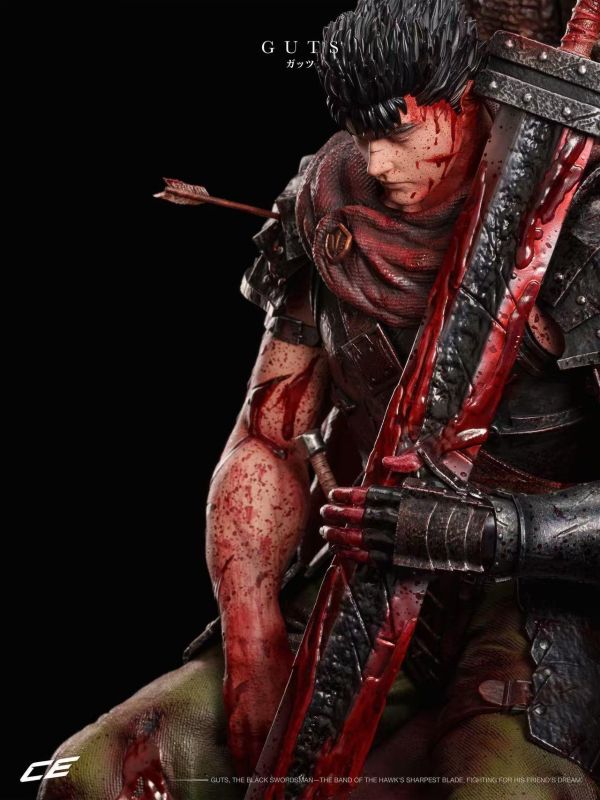
The scratches, blood, damaged armor, and worn surfaces help explain why Guts is resting against the tree in the first place.
The character does not look like he simply chose a comfortable place to sit.
He looks like someone who had no choice but to stop.
That difference gives the statue its emotional weight.
The damaged costume also creates more visual texture across the figure. Smooth armor surfaces contrast with rough scratches, fabric folds, exposed skin, and darker weathering.
Consequently, the statue becomes more interesting to examine at close range.
Collectors who enjoy studying sculpt and paintwork will find plenty of small details across Guts’ battle-worn appearance.
The Tree Is More Than a Background
The enormous tree behind Guts could have been treated as a simple backdrop.
Instead, it becomes part of the storytelling.
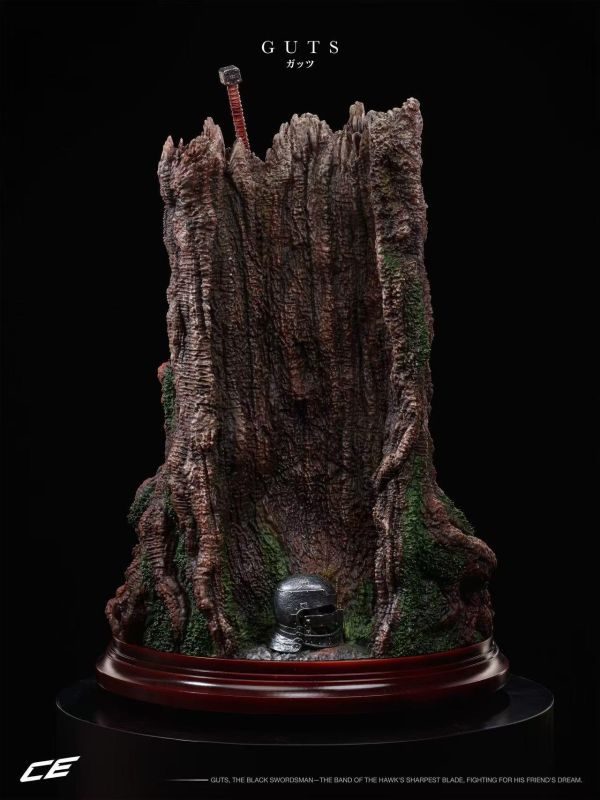
Its surface is covered with deep cracks, rough bark, scars, and irregular textures. The trunk has an aged, almost lifeless appearance that fits the bleak atmosphere of Berserk.
The shape also works naturally with Guts’ pose.
His body leans against the tree because he needs its support. In turn, the tree visually supports the entire composition.
This creates an interesting relationship between character and environment.
Guts is exhausted.
The tree is decayed.
The battlefield around them is damaged.
Nothing in the scene feels untouched.
That shared sense of wear makes the diorama feel cohesive rather than simply decorative.
A Dark Fantasy Diorama Built Around Silence
Many premium Berserk resin statues compete for attention through scale, action effects, or enormous monster bases.
This one takes a different route.
There are no overwhelming flames.
There is no army of enemies surrounding Guts.
Instead, the visual impact comes from silence.
The twisted roots spread across the ground. The tree rises behind him. The Dragonslayer rests nearby. Guts remains seated in the center of it all.
That restraint makes the scene feel surprisingly intimate.
For collectors who prefer darker and more mature displays, this atmosphere can be particularly appealing.
It feels closer to a moment from a dark fantasy illustration than a traditional action figure.
Why the 1/4 Scale Matters
At approximately 60 cm tall, this is a substantial 1/4 scale Guts statue.
That size is important because the concept depends heavily on environmental detail.
The tree needs enough height to frame Guts properly. The roots need enough space to spread across the base. Meanwhile, the Dragonslayer needs room to maintain its imposing proportions.
At a smaller scale, many of those relationships could become compressed.
At 1/4 scale, however, the composition has room to breathe.
The result is a statue that can function as a dedicated centerpiece rather than simply another figure on a crowded shelf.
Of course, the approximately 41 × 41 cm footprint also means collectors should consider their available display space before ordering.
This is a piece that benefits from having room around it.
The Collector Who Wants More Than “Battle Pose Guts”
For longtime Berserk fans, collecting Guts can eventually create an interesting problem.
There are many interpretations of the Black Swordsman.
Some focus on the armor.
Others emphasize the Dragonslayer.
Some recreate famous combat moments.
So what happens when your collection already contains an aggressive, battle-ready Guts?
A quieter interpretation can provide a completely different visual rhythm.
The “Leaning Against the Tree” Guts statue does not compete by trying to make the character look more powerful.
Instead, it emphasizes vulnerability.
That makes it particularly interesting for collectors who appreciate the darker storytelling side of Berserk.
The Emotional Core: Exhaustion Without Defeat
The most effective detail in this statue may not be the Dragonslayer or the tree.
It is Guts’ posture.
His body communicates exhaustion.
His head is lowered.
His muscles appear to have lost their immediate tension.
But the character does not look defeated.
That distinction is crucial.
Guts has always been defined by his refusal to stop moving forward, even when the world gives him almost every reason to do so.
The statue captures that idea without needing a dramatic facial expression.
His continued grip on the Dragonslayer is enough.
He is resting.
He is not surrendering.
A Different Kind of Berserk Display Centerpiece
Picture this statue inside a darker display cabinet.
A focused light falls across Guts’ armor.
The Dragonslayer catches the light beside him.
The rough tree rises behind the character, while the roots disappear into the surrounding ground.
There is no need for a complicated background.
The statue already creates its own atmosphere.
That makes it especially suitable for collectors who want a Berserk display centerpiece with a strong narrative presence.
It can also provide visual contrast if the rest of your collection consists primarily of characters frozen in combat poses.
Instead of another figure ready to attack, you have the moment immediately afterward.
That difference can make an entire shelf feel more intentional.
Why Storytelling Matters in Premium Resin Collecting
As collectors move from standard figures toward large resin statues, expectations often change.
A character’s likeness is still important.
Sculpt quality matters.
Paintwork matters.
Scale matters.
However, premium pieces increasingly compete through storytelling.
Collectors want something that can hold their attention months or even years after the initial purchase.
A strong scene helps accomplish that.
With CE Studio’s Guts, the story is immediately understandable:
The battle is over for now.
The warrior is wounded.
The weapon remains beside him.
The world around him is broken.
But Guts is still there.
That is a simple narrative, yet it fits the emotional language of Berserk extremely well.
Built for the Collector Who Appreciates the Darker Side of Berserk
Not every Berserk fan wants a statue that screams for attention.
Some collectors prefer atmosphere over spectacle.
They want a piece that rewards close inspection rather than relying entirely on dramatic effects.
For those displays, this CE Studio Guts 1/4 statue has a very different appeal.
The aged tree, weathered armor, damaged sword, twisted roots, and exhausted pose create a unified visual language.
Nothing feels particularly clean.
Nothing feels untouched.
That is precisely what makes the scene convincing.
Final Thoughts: Even After Everything, Guts Still Stands
CE Studio’s “Leaning Against the Tree” does not portray Guts at his strongest.
It portrays him when strength is almost gone.
That is exactly why the statue can leave such a strong impression.
The Black Swordsman is wounded. His body needs rest. His armor carries the evidence of another brutal encounter. Yet his Dragonslayer remains within reach, and there is still a sense that he will eventually stand again.
For a character whose entire story revolves around continuing despite impossible circumstances, that feels remarkably appropriate.
The 1/4 scale, substantial 60 cm height, detailed tree diorama, weathered Dragonslayer, and battle-damaged sculpt give the piece enough physical presence to become a serious collection centerpiece. More importantly, the quiet composition gives it something that many action-focused statues lack: a story that continues in your imagination after the battle has ended.
If you’re searching for a Berserk Guts statue that goes beyond the standard fighting pose, CE Studio’s “Leaning Against the Tree” offers a darker and more contemplative interpretation of the Black Swordsman.
👉 Explore the CE Studio Guts “Leaning Against the Tree” 1/4 Statue on TopGK and take a closer look at this post-battle Berserk centerpiece.
Which version of Guts would you rather display: the warrior in the middle of battle, or the Black Swordsman who has survived it?