
 TopGK
TopGK Shop All

![The Legend of Zelda Link 1/6 Scale TOPGK Statue[R18] In Stock-MintBoy Studio - Photo 13 | TopGKStore](https://topgkstore.com/wp-content/uploads/2026/03/The-Legend-of-Zelda-Link-16-Scale-TOPGK-StatueR18-In-Stock-MintBoy-Studio-9-100x100.webp)
 By Source Type

Best-selling products
The Blood Rain – How Manas SUM Reimagines Sun Wukong as a Work of Contemporary Mythological Art
Jul
Every Civilization Leaves Behind an Eternal Hero
Every civilization preserves certain figures that gradually transcend the stories from which they were born.
Some become kings remembered by history.
Others become saints revered through faith.
However, only a remarkable few evolve into timeless cultural symbols that continue to inspire artists centuries after their creation.
Among them, Sun Wukong occupies a place unlike any other.
Known throughout the world as the Monkey King, he has long outgrown the pages of Journey to the West. Instead, he has become a universal symbol of rebellion, perseverance, freedom, and spiritual transformation. Consequently, every generation discovers a different Sun Wukong, shaped not only by literature but also by painting, opera, cinema, animation, sculpture, and contemporary visual art.
Because of this, every serious artistic interpretation inevitably enters a dialogue with one of the greatest mythological traditions in East Asia.
More Than Journey to the West
For many audiences, Sun Wukong is immediately associated with his legendary victories.
The Battle in Heaven.
The Golden Cudgel.
The Seventy-Two Transformations.
The fearless warrior challenging destiny itself.
Yet, these iconic moments represent only one chapter of his artistic identity.
Throughout history, painters and sculptors have often been less interested in his triumphs than in the emotions hidden beneath them. They ask different questions.
What remains after the battle?
What does immortality cost?
How does an invincible warrior carry the weight of endless conflict?
Rather than celebrating power alone, these interpretations explore endurance, sacrifice, and resilience.
As a result, Sun Wukong continues to evolve from a literary hero into a profound artistic subject capable of expressing ideas far beyond mythology.
The Blood Rain Rejects the Familiar Hero
This is precisely where The Blood Rain distinguishes itself.
Instead of portraying the Monkey King at the height of victory, Manas SUM deliberately chooses an entirely different narrative moment.
The battle has already ended.
The roar of combat has disappeared.
The clouds have settled.
Only silence remains.
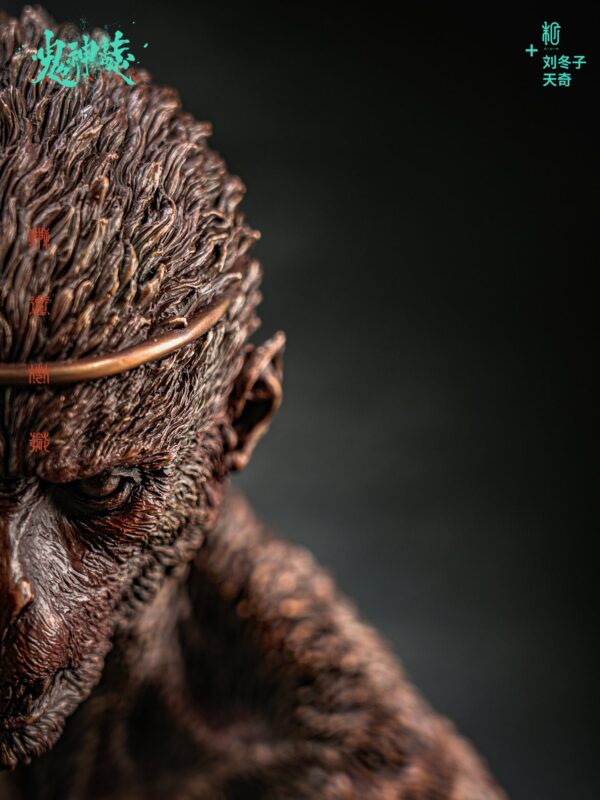
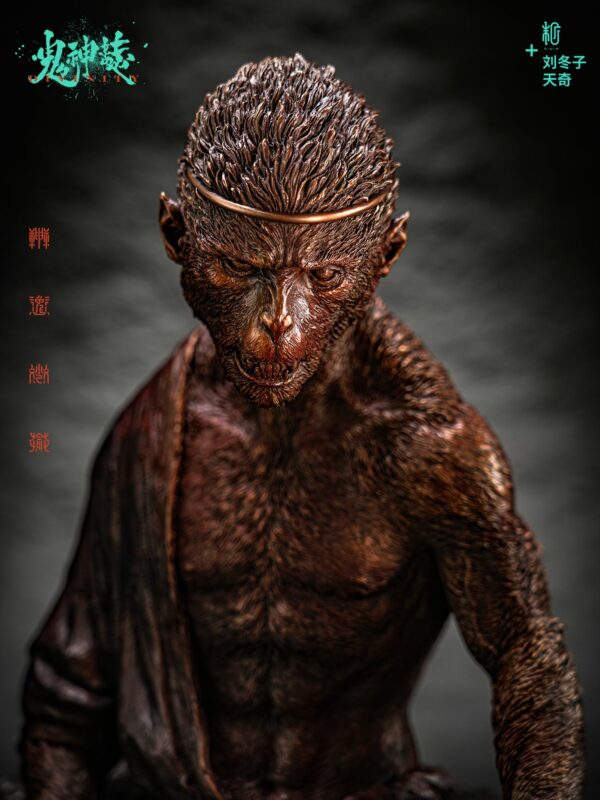
Standing within that silence is a warrior covered in blood, scarred by conflict, yet refusing to bow.
Because of this, the sculpture immediately avoids the familiar visual language seen in many Sun Wukong Statues.
There is no triumphant gesture.
No theatrical celebration.
No exaggerated display of invincibility.
Rather, the work presents a hero who has already paid the price of greatness.
That artistic decision fundamentally changes the viewer’s relationship with the sculpture.
Silence Becomes the Strongest Narrative
One of the most remarkable qualities of The Blood Rain is its confidence in restraint.
Many contemporary collectibles rely upon dramatic movement to capture attention.
However, this sculpture embraces stillness.
Its emotional power emerges gradually rather than immediately.
Instead of asking viewers to admire action, it invites them to contemplate consequence.
The blood no longer symbolizes violence.
Rather, it symbolizes survival.
The damaged body no longer communicates defeat.
Instead, it reflects endurance.
Even the posture avoids unnecessary heroism.
Consequently, the emotional narrative unfolds through quiet observation rather than spectacle.
This is the language of contemporary sculpture rather than commercial merchandise.
Myth Reinterpreted Through Contemporary Art
Although deeply rooted in Chinese mythology, The Blood Rain feels surprisingly modern.
Rather than functioning as a literal illustration of Journey to the West, it interprets mythology through universal human emotion.
Exhaustion.
Determination.
Loss.
Perseverance.
These emotions require no cultural explanation.
Therefore, viewers unfamiliar with the original novel can still understand the sculpture instinctively.
Its visual language becomes international while remaining unmistakably Chinese.
As a result, the work bridges traditional mythology and contemporary fine art with remarkable confidence.
Why Manas SUM Takes a Different Artistic Direction
Every sculpture reflects the philosophy of the artist behind it.
In the case of Manas SUM, the objective extends beyond reproducing recognizable characters.
Instead, the studio consistently pursues emotional storytelling through sculptural form.
Surface detail exists to support atmosphere.
Composition exists to support narrative.
Texture exists to support memory.
Consequently, the sculpture never feels designed merely for display.
It feels designed for contemplation.
This philosophy places The Blood Rain much closer to gallery sculpture than to conventional pop-culture collectibles.
A Sculpture That Rewards Time
Most commercial statues reveal everything within a few seconds.
Viewers notice the pose.
The costume.
The likeness.
Then they move on.
The Blood Rain behaves differently.
Instead, it rewards patience.
Each additional observation reveals another subtle decision.
The weathered textures suggest countless unseen battles.
The restrained composition encourages slower viewing.
The blood gradually transforms from decoration into symbolism.
Meanwhile, the expression begins to communicate something far more profound than anger.
It speaks of responsibility.
It speaks of burden.
It speaks of the quiet determination to continue despite unimaginable hardship.
Because of this, the sculpture becomes richer with repeated viewing, a quality more commonly associated with museum pieces than collectible statues.
Beyond Collecting
Collectors often ask whether a sculpture is accurate.
Whether it resembles the source material.
Whether the likeness is faithful.
Those questions certainly matter.
However, they are not the questions that define The Blood Rain.
The more meaningful question becomes:
Does this sculpture deepen our understanding of Sun Wukong?
In this case, the answer is undeniably yes.
Rather than preserving a familiar image, it expands the mythology itself.
It transforms the Monkey King from an invincible legend into a timeless meditation on endurance.
That transformation ultimately becomes the sculpture’s greatest artistic achievement.
Part 1 Closing
Ultimately, The Blood Rain demonstrates that mythology does not remain alive because stories are repeatedly retold.
Instead, mythology survives because artists continue finding new emotional truths within familiar legends.
By choosing the silence after the battle instead of the glory before it, Manas SUM offers a version of Sun Wukong that feels unexpectedly human while remaining unmistakably immortal.
To fully appreciate that achievement, however, one must move beyond the legend itself and examine the sculpture as an object of artistic craftsmanship. In Part 2, we will explore how composition, material, texture, weathering, sculptural balance, and visual rhythm transform The Blood Rain from a collectible statue into a contemporary work of mythological art.
Great Sculpture Is Not Measured by Detail Alone
Collectors often begin by asking familiar questions.
How accurate is the likeness?
How realistic is the paintwork?
How intricate are the textures?
Although these are important considerations, they rarely explain why a sculpture continues to resonate years after it enters a collection.
Instead, truly memorable works succeed because every visual element contributes to a single emotional idea.
That principle lies at the heart of The Blood Rain.
Rather than overwhelming the viewer with technical complexity, Manas SUM carefully orchestrates composition, proportion, texture, and atmosphere into one unified visual narrative. Consequently, the sculpture feels less like an isolated object and more like a frozen moment suspended between mythology and memory.
Composition Before Detail
One of the first qualities that distinguishes The Blood Rain is its compositional discipline.
Many modern Sun Wukong Statues attempt to communicate energy through explosive movement.
Flying robes.
Shattered rocks.
Sweeping staffs.
Violent diagonals.
However, Manas SUM deliberately moves in the opposite direction.
The composition remains remarkably restrained.
Every line guides the eye with quiet precision.
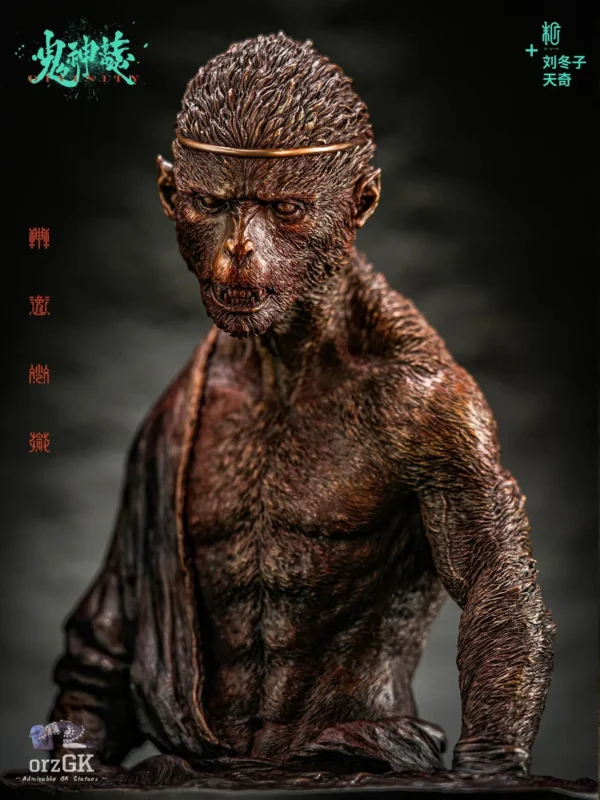
The viewer naturally travels upward from the weathered base to the blood-stained Golden Cudgel, continues toward the battle-worn body, and finally arrives at the Monkey King’s unwavering gaze.
Because of this, the sculpture creates visual rhythm rather than visual noise.
The longer one observes it, the more carefully balanced every element appears.
The Power of Stillness
Perhaps the sculpture’s greatest achievement is its understanding of stillness.
In sculpture, movement often attracts immediate attention.
Yet, stillness frequently carries greater emotional weight.
Here, Sun Wukong is not charging toward an enemy.
He is not celebrating victory.
He is not demonstrating supernatural power.
Instead, he simply stands.
That decision transforms the entire narrative.
The viewer begins imagining the battle that has already taken place rather than watching one unfold.
Consequently, the sculpture invites participation instead of passive observation.
Every collector inevitably constructs a different story.
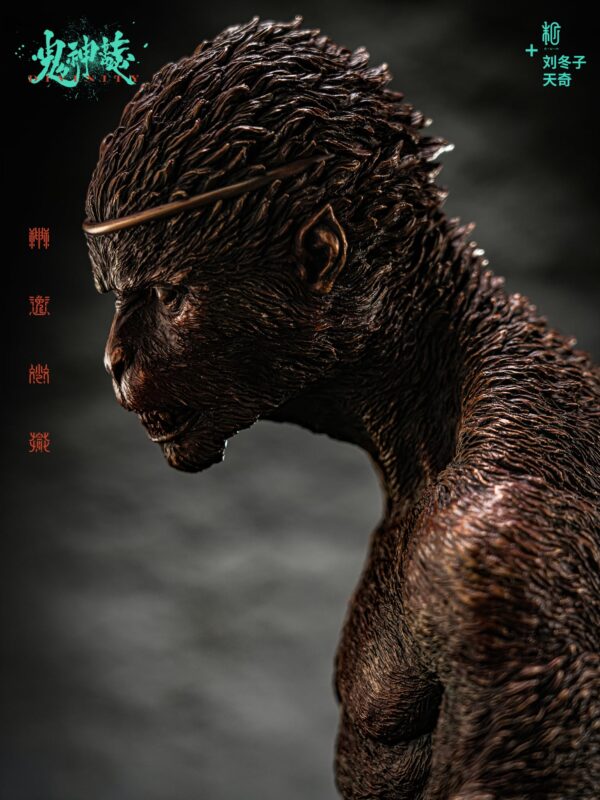
The Face: Where Defiance Replaces Anger
A sculpture lives or dies through its expression.
Fortunately, Manas SUM understands that the Monkey King requires something more nuanced than rage.
His face does not scream.
Neither does it seek sympathy.
Instead, it communicates absolute resolve.
The eyes remain focused.
The jaw remains composed.
The expression carries neither triumph nor despair.
Rather, it suggests an individual who has endured every imaginable hardship and still refuses to surrender.
Because of this, the emotional impact becomes remarkably mature.
The sculpture does not ask the viewer to admire strength.
It asks the viewer to contemplate resilience.
Surface Texture as Visual Storytelling
Meanwhile, the surface treatment deserves equal attention.
Many premium resin statues pursue flawless finishes.
However, perfection would undermine the narrative here.
Every fracture.
Every weathered edge.
Every worn layer of fabric.
Every scar carved into the armor.
Together, they function as visual evidence of countless unseen battles.
The sculpture never explicitly explains where those marks originated.
Instead, it allows the viewer’s imagination to complete the story.
This restraint demonstrates considerable artistic confidence.
Blood as Symbol Rather Than Decoration
Perhaps the most misunderstood element is the blood itself.
On many commercial collectibles, blood serves primarily as visual spectacle.
It exists to increase intensity.
The Blood Rain, however, approaches it differently.
The crimson accents never dominate the sculpture.
Instead, they appear carefully controlled, almost restrained.
Their purpose is symbolic rather than theatrical.
They remind us that every legend demands sacrifice.
They acknowledge that even immortality carries consequences.
Consequently, the blood ceases to represent violence alone.
It becomes a visual language for endurance.
Material That Disappears Behind the Art
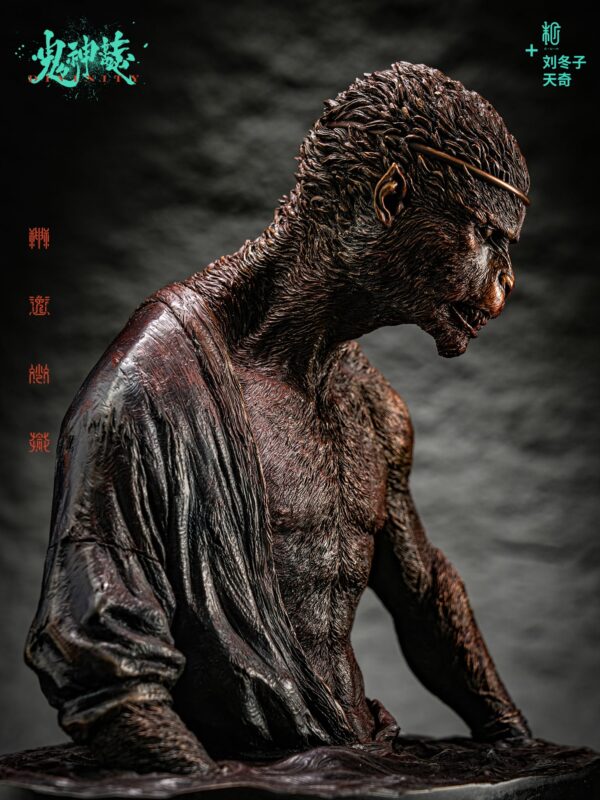
Premium resin remains the foundation of the sculpture.
Yet, the material itself never becomes the focus.
Instead, the craftsmanship allows resin to imitate the qualities of far older artistic mediums.
Weathered stone.
Aged bronze.
Centuries-old carved wood.
Because of this, viewers become less aware of manufacturing and more aware of sculpture.
That distinction separates collectible production from artistic creation.
The medium quietly disappears.
Only the artwork remains.
The Dialogue Between Figure and Base
Many display bases function merely as structural support.
By contrast, the base in The Blood Rain behaves as narrative architecture.
It grounds the Monkey King physically.
Meanwhile, it anchors him emotionally within the aftermath of conflict.
Its fractured textures echo the damage carried by the figure above.
Its irregular forms prevent the composition from feeling static.
Furthermore, the transition between base and figure appears seamless, allowing the environment to become part of the storytelling rather than an independent accessory.
Every Viewing Angle Creates a Different Narrative
Another remarkable quality is the sculpture’s multidirectional composition.
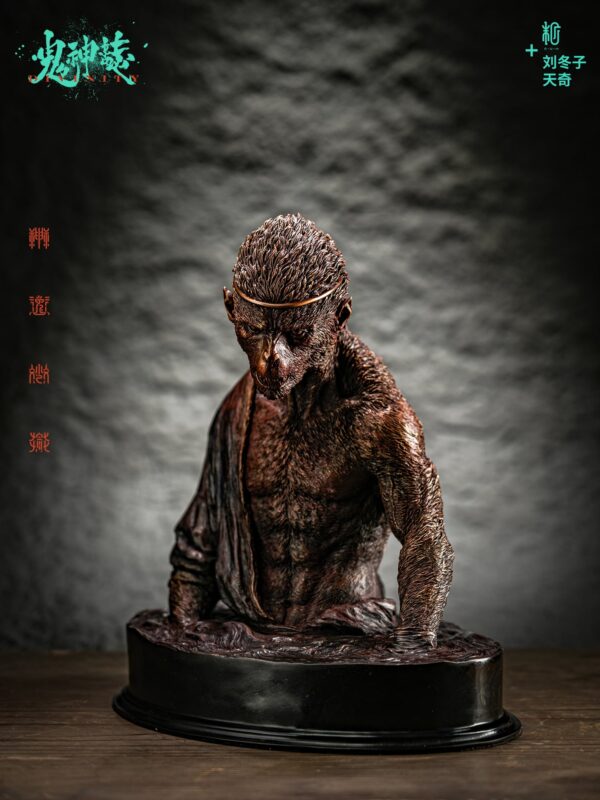
Viewed from the front, the Monkey King appears calm yet immovable.
Viewed from the side, the silhouette suddenly feels heavier, emphasizing fatigue beneath unwavering determination.
Viewed from behind, the damaged garments and flowing forms suggest the long journey already traveled.
Therefore, the sculpture never relies upon a single “best angle.”
Instead, each perspective reveals new emotional information.
This characteristic is far more common in gallery sculpture than in traditional commercial collectibles.
The Difference Between Representation and Interpretation
Ultimately, The Blood Rain succeeds because it refuses to become a literal illustration.
Many statues faithfully reproduce a character.
Manas SUM chooses something more ambitious.
It interprets him.
Rather than asking, “What does Sun Wukong look like?”
The sculpture asks,
“What does Sun Wukong represent after everything has been lost?”
That philosophical shift elevates the work beyond fandom.
It enters the realm of contemporary mythological sculpture.
Ultimately, the artistic achievement of The Blood Rain lies not in extraordinary technical precision alone, but in its ability to transform sculptural craftsmanship into emotional storytelling.
Every compositional choice, every weathered texture, every restrained application of color, and every carefully balanced proportion contributes to a work that rewards prolonged observation rather than immediate spectacle.
Rather than illustrating one scene from Journey to the West, Manas SUM creates a timeless meditation on perseverance, sacrifice, and the enduring spirit of the Monkey King.
Beyond Collecting: Why The Blood Rain Deserves to Be Viewed as Contemporary Mythological Sculpture
Some Sculptures Decorate a Space. Others Transform It.
By the time a collector encounters The Blood Rain, the question is rarely whether the sculpture is technically impressive.
Instead, the more meaningful question becomes whether it possesses the ability to endure—both visually and emotionally—long after the excitement of a new acquisition has faded.
Many collectibles are designed to capture immediate attention.
Dynamic poses, elaborate effects, and overwhelming visual spectacle often create an unforgettable first impression.
However, first impressions are only one measure of artistic success.
A truly significant sculpture continues revealing new ideas years later.
Because of this, collectors often return to the finest works not because they have forgotten them, but because they continue discovering something new within them.
The Blood Rain belongs firmly to that category.
The Difference Between a Collectible and a Work of Art
The contemporary collectible market has grown enormously over the past decade.
Consequently, technical standards have risen dramatically.
Exceptional sculpting has become common.
Complex paint applications have become expected.
Premium resin has become the industry standard.
Yet, craftsmanship alone rarely separates memorable sculpture from lasting art.
Instead, enduring works are defined by intention.
Every artistic decision should support a larger narrative.
Every texture should communicate something beyond realism.
Every composition should encourage interpretation rather than simply displaying information.
Because of this, The Blood Rain feels remarkably different from many premium Sun Wukong Statues.
It does not merely reproduce an iconic character.
It interprets one of humanity’s greatest mythological figures through the language of contemporary sculpture.
Sun Wukong as a Universal Symbol
Although Sun Wukong originates from Journey to the West, his significance extends far beyond classical Chinese literature.
Over time, he has become one of the world’s most recognizable mythological heroes.
Artists continue returning to the Monkey King because his story speaks to universal human experience.
Defiance against impossible authority.
The pursuit of freedom.
The consequences of pride.
The search for enlightenment.
The willingness to continue despite overwhelming adversity.
Therefore, every generation inevitably creates its own interpretation of Sun Wukong.
Painters reinterpret him.
Writers reinterpret him.
Filmmakers reinterpret him.
Likewise, sculptors continue asking what new emotional truths remain hidden within an ancient legend.
Rather than repeating familiar imagery, The Blood Rain answers that question with remarkable restraint.
Why Restraint Ages Better Than Spectacle
One of the most fascinating characteristics of museum collections is how quietly many masterpieces command attention.
They rarely depend upon excess.
Instead, they reward patience.
Similarly, The Blood Rain avoids visual overload.
Its composition remains disciplined.
Its symbolism remains measured.
Its emotional tone remains controlled.
Consequently, the sculpture never feels tied to temporary artistic trends.
Rather than competing for attention, it quietly earns it.
That distinction becomes increasingly valuable as collections mature.
Collectors often discover that sculptures built upon emotional depth continue satisfying long after purely spectacular pieces begin to feel familiar.
The Lasting Appeal of Mythological Sculpture
Unlike characters whose popularity depends upon a single film, television series, or game release, mythological figures possess extraordinary longevity.
For centuries, artists have continued reimagining the same stories through entirely different visual languages.
Because of this, mythological sculpture occupies a unique position within contemporary collecting.
Its relevance rarely depends upon current entertainment trends.
Instead, it draws strength from cultural memory itself.
Sun Wukong belongs to that rare tradition.
His legend has survived generations of artistic transformation.
Therefore, a thoughtfully executed Monkey King Statue represents more than fan appreciation.
It becomes part of an artistic conversation that has continued for hundreds of years.
Why Manas SUM’s Interpretation Matters
Every studio can reproduce anatomy.
Many studios can produce impressive textures.
Only a handful consistently communicate atmosphere.
Here, Manas SUM demonstrates that sculpture is capable of expressing philosophy as effectively as technique.
Rather than celebrating invincibility, the studio explores endurance.
Rather than emphasizing conquest, it emphasizes consequence.
Rather than presenting mythology as fantasy, it presents mythology as emotional experience.
As a result, The Blood Rain achieves something increasingly uncommon within premium collectibles.
It invites reflection before admiration.
Who Will Appreciate The Blood Rain Most?
Although every collector approaches sculpture differently, this work speaks especially strongly to several audiences.
First, collectors of Chinese Mythology Sculptures will appreciate its respectful yet contemporary interpretation of one of China’s greatest cultural icons.
Meanwhile, enthusiasts of museum-quality resin art will recognize its disciplined composition, restrained storytelling, and sophisticated sculptural language.
Furthermore, collectors interested in fine art-inspired works rather than purely character merchandise will find that its emotional depth rewards repeated viewing.
Finally, admirers of Sun Wukong himself will discover a portrayal that expands rather than repeats the familiar legend, offering a perspective rarely explored in collectible sculpture.
Product Information
Product Name: The Blood Rain
Studio: Manas SUM
Character: Sun Wukong (Monkey King)
Series: Licensed Original Artwork
Product Type: Premium Resin Sculpture
Material: High-Quality Resin
Available Editions: Standard Resin, Heavy Blood Resin, Bronze Edition
Category: Chinese Mythology Sculpture
Collection Style: Museum-Quality Fine Art Collectible
Frequently Asked Questions
Why is The Blood Rain different from traditional Sun Wukong statues?
Rather than depicting the Monkey King during a moment of triumph, it focuses on the emotional aftermath of conflict, emphasizing resilience instead of victory.
Is this sculpture inspired directly by Journey to the West?
Yes, however, it should be understood as a contemporary artistic interpretation rather than a literal scene from the novel.
Why does the sculpture use restrained blood effects instead of dramatic action?
Because the blood functions symbolically, representing sacrifice, endurance, and the emotional cost of becoming a legendary figure.
Who is this sculpture intended for?
Collectors of premium resin sculptures, Chinese mythology enthusiasts, fine art collectors, and anyone seeking museum-quality contemporary collectible art.
Why is Manas SUM highly regarded among collectors?
Because the studio consistently prioritizes narrative composition, artistic atmosphere, and emotional storytelling over simple visual spectacle.
Final Reflection — When Myth Becomes Sculpture
Ultimately, the greatest sculptures do not preserve appearances alone.
They preserve ideas.
They preserve emotions.
They preserve the invisible weight carried by legendary figures long after their stories have been told.
The Blood Rain achieves exactly that.
It reminds us that heroism is rarely defined by the moment of victory.
Instead, it is revealed in the quiet determination to remain standing after everything has been lost.
Through disciplined composition, restrained symbolism, exceptional craftsmanship, and profound emotional resonance, Manas SUM transforms Sun Wukong from a legendary warrior into something even more enduring—a timeless work of contemporary mythological art.
Consequently, this sculpture deserves to be appreciated not only as a premium Sun Wukong Statue or Monkey King Collectible, but as an artwork capable of standing comfortably alongside modern sculptural interpretations of mythology.
For collectors seeking more than visual spectacle—for those searching for meaning, atmosphere, and lasting artistic value—The Blood Rain offers an experience that extends well beyond collecting.
It offers a new way of seeing one of the world’s greatest legends.
Product Page: