
 TopGK
TopGK Shop All



![The Legend of Zelda Link 1/6 Scale TOPGK Statue[R18] In Stock-MintBoy Studio - Photo 13 | TopGKStore](https://topgkstore.com/wp-content/uploads/2026/03/The-Legend-of-Zelda-Link-16-Scale-TOPGK-StatueR18-In-Stock-MintBoy-Studio-9-100x100.webp)
 By Source Type



Best-selling products
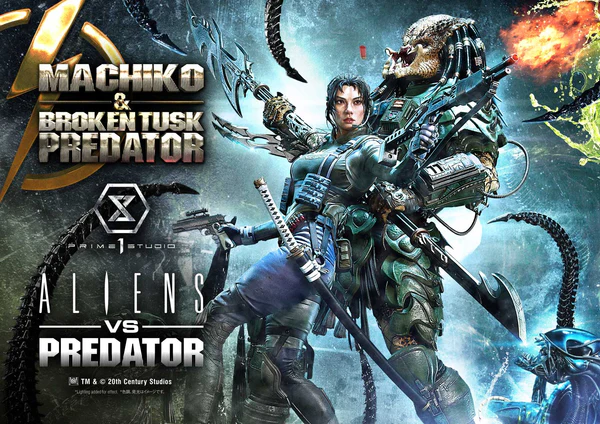
Prime 1 Studio Alien vs Predator Machiko & Broken Tusk Statue – The Ultimate Premium Masterline Collector’s Grail
Jun
Prime 1 Studio Alien vs Predator Machiko & Broken Tusk Statue – The Ultimate Premium Masterline Collector’s Grail
Explore Prime 1 Studio AVP Machiko & Broken Tusk 1/4 Statue
There is a very specific moment every serious collector eventually recognizes—but almost never admits.
You scroll through another high-end statue release, you see incredible sculpt detail, museum-level paintwork, cinematic composition… and yet, instead of excitement, you feel something closer to restraint.
Because at a certain level of collecting, the question is no longer “Is this impressive?”
It becomes:
“Does this deserve space in my collection at all?”
That is exactly where the Prime 1 Studio Ultimate Premium Masterline Alien vs Predator Machiko & Broken Tusk 1/4 statue enters—not as another premium release, but as a benchmark piece that forces collectors to reconsider what “grail-level” actually means.
Why Serious Collectors Are Becoming More Selective Than Ever
Over the past decade, the high-end statue market—especially licensed cinematic and comic IPs—has reached a point of extreme refinement.
On the surface, this looks like pure progress. Sculpt quality is higher. Paint techniques are more advanced. Diorama storytelling is more cinematic than ever.
However, something subtle has changed underneath.
When everything becomes premium, premium stops being rare.
As a result, collectors begin to experience a different kind of fatigue—less about quality, and more about differentiation.
Many pieces are objectively excellent, yet they start to feel interchangeable in emotional impact.
That is why modern collectors are no longer just buying “well-made statues.”
Instead, they are searching for something much harder to define:
a centerpiece that still feels irreplaceable years later.
And this is where the Machiko & Broken Tusk diorama becomes fundamentally different.
A Rare Crossover Moment That Actually Feels Cinematic
The Alien vs Predator universe has been explored in countless formats, but few adaptations manage to capture the emotional complexity of this specific pairing.
Machiko Noguchi and Broken Tusk Predator represent something unusual in sci-fi collectibles:
Not just conflict—but mutual recognition.
Instead of simple enemy confrontation, this composition carries layered tension. There is hostility, yes—but also respect, survival logic, and narrative weight.
Prime 1 Studio does not treat this as a static “versus pose.”
Instead, the diorama behaves like a frozen cinematic frame extracted from a larger story that never fully resolves.
That is a critical difference.
Because in high-end collecting, storytelling is not about what is shown.
It is about what is implied.
The Real Collector Problem: Oversaturation of “Impressive” Pieces
Most collectors do not suffer from lack of options.
In fact, the opposite is true.
The market is saturated with highly detailed statues that all compete at a similar visual tier.
At that point, a new problem appears:
Even exceptional pieces start blending into each other emotionally.
This leads to a subtle but important shift in behavior:
Collectors stop asking “Is this good?”
And start asking:
“Will this still feel important when I walk past it every day?”
That is where many purchases fail long-term—not in quality, but in permanence of impact.
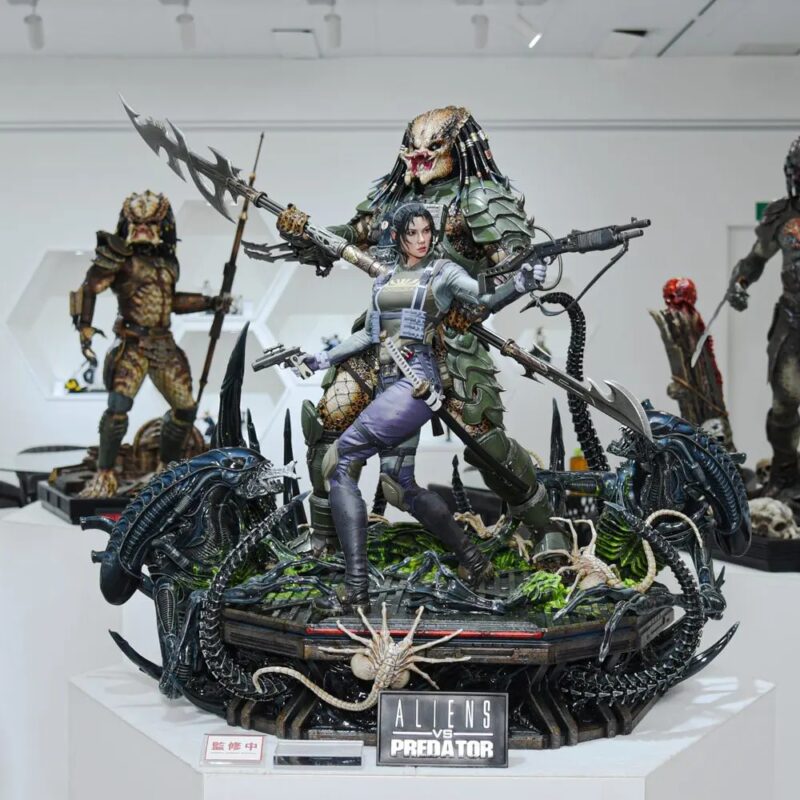
The Machiko & Broken Tusk 1/4 statue addresses this directly through composition hierarchy.
Instead of relying on a single focal character, it creates dual narrative gravity.
Your eye does not settle in one place—it moves between tension points, constantly reinterpreting the scene.
That alone increases long-term visual engagement significantly.
Prime 1 Studio Execution: Where Museum-Level Craft Meets Narrative Weight
Prime 1 Studio’s Ultimate Premium Masterline line is not designed for casual display.
It is designed for collectors who treat statues as spatial installations rather than shelf objects.
In this piece, several design elements stand out immediately:
First, the anatomical precision of both Machiko and Broken Tusk reflects extremely high sculpt fidelity, staying faithful to their respective source designs while enhancing realism for 3D presentation.
Second, the environmental base is not decorative—it is structural storytelling. Every texture element contributes to the sense of aftermath and tension rather than static decoration.
Third, the scale itself matters. At 1/4 scale, presence becomes physical rather than visual. This is not a piece you simply “look at”—it occupies space in a way that changes how the room feels.
This is where many collectors realize the difference between “large statue” and “dominant statue.”
They are not the same category.
The Psychological Shift: From Collection to Curation
At a certain point, experienced collectors stop thinking in terms of acquisition.
Instead, they begin thinking in terms of curation logic:
What stays visible
What defines the room
What anchors attention
What earns permanent placement
In that mindset, every new piece must justify its existence not just visually, but structurally within the collection.
This is where most statues fail—not because they are weak, but because they do not change the hierarchy of the display.
The Machiko & Broken Tusk diorama, however, naturally establishes hierarchy through dual-character interaction.
It does not sit in the collection.
It organizes it.
Why This Piece Resonates With Mature Collectors
There is a reason Alien vs Predator continues to hold collector relevance decades after its original popularity peak.
It is not nostalgia alone.
It is thematic maturity.
Unlike many action IPs, AVP carries philosophical tension: coexistence through conflict, survival ethics, and mutual recognition between opposing species.
That emotional complexity translates extremely well into high-end statue form.
And Prime 1 Studio amplifies that narrative instead of simplifying it.
For mature collectors, that matters more than surface-level spectacle.
Display Impact: Why Scale and Composition Change Everything
In practical terms, 1/4 scale statues operate on a different psychological level compared to smaller collectibles.
They do not sit in a collection—they dominate it.
This specific diorama, with its dual-character composition, creates a visual anchoring effect that reorganizes surrounding pieces automatically.
Everything nearby becomes secondary.
That is not exaggeration—it is spatial hierarchy at work.
And for collectors building themed rooms or premium display cabinets, that effect is often exactly what they are looking for.
Who This Statue Is Actually For
This is not a casual purchase.
It is not designed for entry-level collectors or impulse buyers.
Instead, it aligns with three types of serious buyers:
First, collectors who prioritize cinematic dioramas over single-character statues.
Second, Alien vs Predator fans who value lore accuracy combined with artistic enhancement.
Third, high-end collectors who curate display environments rather than accumulate individual items.
For these audiences, the decision is not about “liking the piece.”
It is about whether the piece belongs in their permanent visual architecture.
Final Perspective: A Piece That Demands Space, Not Attention
Many statues try to capture attention.
This one does something different.
It assumes attention is already given—and instead focuses on sustaining it over time.
That distinction is what separates premium collectibles from true centerpiece grails.
The Machiko & Broken Tusk diorama is not asking to be admired once.
It is designed to be seen repeatedly, with new details revealed each time you pass by it.
Secure Your Collector Allocation
If you are building a high-end cinematic or sci-fi collection, this is one of those rare pieces that does not simply “fit in.”
It defines the space around it.
View Prime 1 Studio AVP Machiko & Broken Tusk 1/4 Statue
And finally, a question worth asking as a collector:
Are you still adding statues to your collection—or are you now building the visual hierarchy of an entire space?