
 TopGK
TopGK Shop All



![The Legend of Zelda Link 1/6 Scale TOPGK Statue[R18] In Stock-MintBoy Studio - Photo 13 | TopGKStore](https://topgkstore.com/wp-content/uploads/2026/03/The-Legend-of-Zelda-Link-16-Scale-TOPGK-StatueR18-In-Stock-MintBoy-Studio-9-100x100.webp)
 By Source Type



Best-selling products
Belief Studio Sukuna 1/6 Resin Statue: Why the Ten Shadows Technique Edition Stands Out
Sep
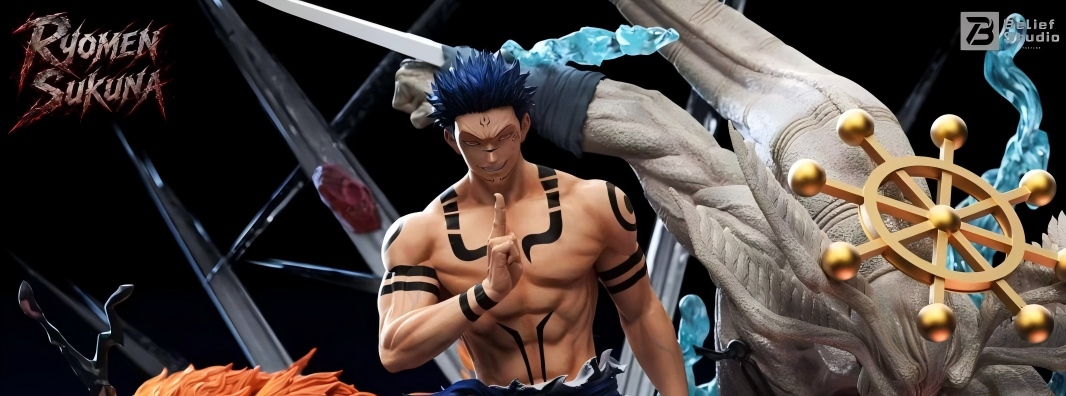
Belief Studio – Jujutsu Kaisen Ryomen Sukuna Ten Shadows Technique 1/6 Scale TOPGK Limited Edition Resin Statue
What happens when the King of Curses gains access to one of the most dangerous cursed techniques in Jujutsu Kaisen?
You get a version of Ryomen Sukuna that feels fundamentally different from the Sukuna most collectors already know.
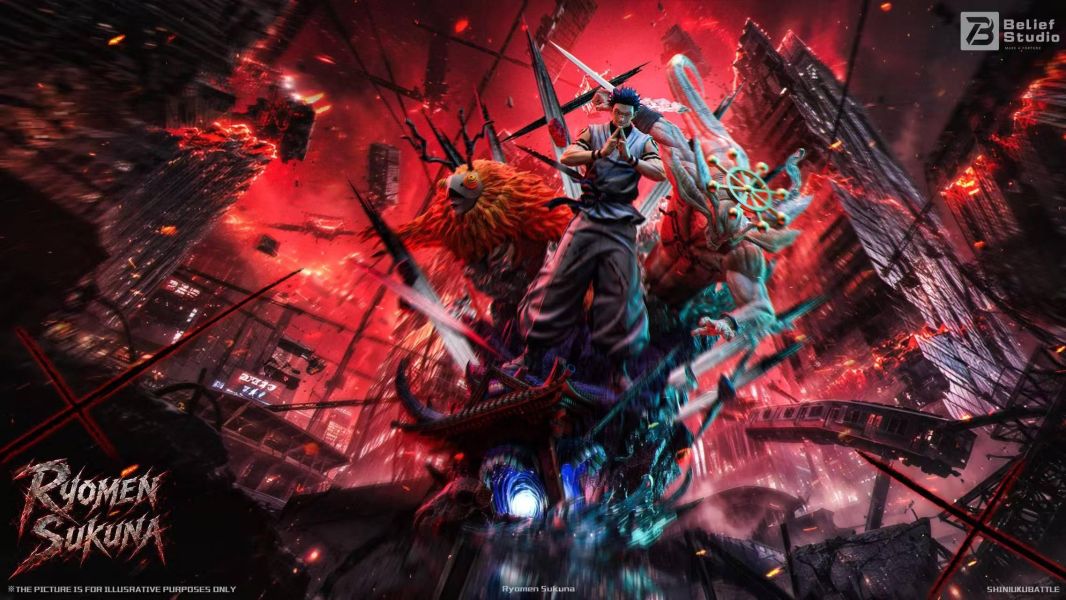
The Belief Studio Ten Shadows Technique Ryomen Sukuna 1/6 Resin Statue focuses on one of the most important developments in Sukuna’s story: his use of the Ten Shadows Technique after taking over Megumi Fushiguro’s body.
Rather than simply sculpting Sukuna in another standing pose, Belief Studio builds the statue around the visual identity of this technique.
The result is a collectible designed for fans who want more than another representation of Sukuna’s face.
It is about power, possession, technique, and the terrifying combination of Sukuna’s personality with the abilities inherited from Megumi’s body.
The statue is produced at 1/6 scale, with an estimated size of approximately 32 cm high × 21 cm wide × 20 cm deep. It is made using resin, PU, and polystone, with production limited to 100 pieces.
For serious Jujutsu Kaisen collectors, those numbers are only the beginning.
The real question is:
Why does the Ten Shadows version of Sukuna deserve its own place in your collection?
Sukuna Is Already One of the Most Collectible Characters in Jujutsu Kaisen
There is an obvious problem with making a new Sukuna statue.
There are already a lot of them.
Sukuna has become one of the defining characters of Jujutsu Kaisen, and his visual design is instantly recognizable.
The tattoos.
The sharp eyes.
The confident expression.
The intimidating presence.
The overwhelming aura of someone who does not need to prove that he is dangerous.
Because of that, simply producing another Sukuna figure is not enough for experienced collectors.
A new statue needs to answer a different question:
What does this version show that the others don’t?
Belief Studio’s answer is the Ten Shadows Technique.
That immediately gives the statue a stronger narrative identity.
Instead of focusing only on Sukuna as the King of Curses, the piece represents the period in which Sukuna’s power was combined with Megumi Fushiguro’s inherited technique.
That combination became one of the most important developments in the series.
And for collectors, it creates a much more specific version of the character.
What Makes Sukuna’s Ten Shadows Version So Important?
The Ten Shadows Technique originally belongs to the Zenin family’s inherited cursed techniques and is associated with Megumi Fushiguro.
The technique allows its user to summon shikigami through shadows, giving the user access to a flexible and highly dangerous combat system.
Sukuna’s interest in Megumi’s technique becomes increasingly important throughout the story.
Once Sukuna takes control of Megumi’s body, he gains access to the Ten Shadows Technique and begins using it in ways that demonstrate just how dangerous the ability can become in the hands of someone with Sukuna’s experience and cursed energy.
This is particularly significant because Sukuna does not simply inherit the technique.
He understands how to exploit it.
That distinction is what makes the concept so frightening.
The Ten Shadows Technique is already powerful.
Give it to Sukuna, and the entire balance changes.
Sukuna + Ten Shadows Is a Completely Different Character Concept
Think about the difference between two statues.
The first simply says:
“This is Sukuna.”
The second says:
“This is Sukuna after gaining control of the Ten Shadows Technique.”
The second immediately gives the collector more context.
It represents a specific chapter of the character’s evolution.
That makes the statue feel closer to a story artifact than a generic character collectible.
For longtime Jujutsu Kaisen fans, this distinction matters.
Collectors often reach a point where they don’t want every possible version of a character.
They want the versions that represent something important.
A Gojo statue representing Unlimited Void.
A Yuji statue representing Black Flash.
A Yuta statue with Rika.
And, in this case:
Sukuna representing the Ten Shadows Technique.
That is a much stronger collecting proposition than simply producing another Sukuna pose.
The Ten Shadows Technique Gives the Statue a Stronger Narrative
One of the biggest advantages of character statues is their ability to freeze a particular moment or idea from a story.
A photograph captures a person.
A statue can capture a character’s transformation.
That is what makes this concept work.
Sukuna’s use of the Ten Shadows Technique represents a major shift in the balance of power within Jujutsu Kaisen.
The technique had already been associated with Megumi.
But once Sukuna obtains it, its meaning changes.
It becomes another weapon in the hands of the series’ most terrifying antagonist.
This creates an interesting psychological element for the statue.
You are not just looking at Sukuna.
You are looking at Sukuna after he has acquired something that was never originally his.
That idea adds weight to the collectible.
Why Mahoraga Is So Closely Connected to This Concept
Any discussion of Sukuna and the Ten Shadows Technique inevitably leads to Mahoraga.
Mahoraga is widely regarded as the most powerful shikigami associated with the Ten Shadows Technique and becomes central to one of the most memorable battles in Jujutsu Kaisen.
The technique’s relationship with Mahoraga is one of the reasons collectors find this particular version of Sukuna so compelling.
Mahoraga represents the extreme end of what the Ten Shadows Technique can offer.
It is not simply another summoned creature.
It represents adaptation, overwhelming strength, and a level of danger that even experienced sorcerers have to take seriously.
Sukuna’s ability to incorporate Ten Shadows into his own fighting style therefore represents more than acquiring another technique.
It represents the combination of two extremely dangerous power systems.
And that is exactly the kind of moment that deserves a premium statue.
Why Collectors Should Care About the Technique, Not Just the Character
There is an important difference between character collecting and story collecting.
Character collecting means:
“I love Sukuna, so I want a Sukuna figure.”
Story collecting means:
“I want this particular Sukuna because this version represents one of the most important moments in the story.”
The second approach usually becomes more important as a collection gets larger.
If you only have a few figures, almost any attractive Sukuna figure can work.
But once your display cabinet contains dozens of Jujutsu Kaisen collectibles, repetition becomes a problem.
You start asking:
- Is the pose different?
- Does the statue represent a specific scene?
- Does it add something new?
- Does the base tell a story?
- Does the piece represent an important transformation?
- Will I still care about this version years from now?
The Ten Shadows concept gives this Belief Studio statue a clear answer.
It represents a specific and highly memorable version of Sukuna.
The 1/6 Scale Is a Smart Choice for Sukuna
Belief Studio produces this statue at 1/6 scale, with an estimated height of approximately 32 cm.
That puts it in an interesting middle ground.
It is substantially larger and more display-oriented than most standard anime figures, but it does not demand the enormous cabinet space associated with many 1/4 or 1/3 scale statues.
For collectors, that makes 1/6 particularly practical.
You get enough physical size for:
- Facial details
- Tattoos
- Hair sculpting
- Clothing folds
- Body proportions
- Technique effects
- Base details
without turning the statue into a piece of furniture.
At around 32 cm tall, the statue should also have enough presence to stand out among standard 1/7 and 1/8 scale figures.
That is particularly useful if Sukuna is intended to be one of the centerpieces of a Jujutsu Kaisen shelf.
Resin Gives the Statue a Different Presence
This is another reason collectors move from PVC figures toward resin statues.
PVC figures are often excellent for affordability and mass production.
Resin statues are designed around a different philosophy.
The goal is not simply to reproduce a character.
The goal is to create a display object.
Belief Studio lists the statue as using resin, PU, and polystone, materials commonly used for larger-scale collectible statues.
The combination allows for more substantial sculptural construction and a heavier physical presence.
When you put a resin statue next to ordinary anime figures, the difference is immediately noticeable.
The resin piece feels like an object designed to stay in one place and become part of the room.
That is exactly what you want from a character like Sukuna.
Sukuna Works Particularly Well as a Resin Statue
Some characters naturally lend themselves to resin statues.
Sukuna is one of them.
Why?
Because his visual identity is built around presence.
He doesn’t need an overly complicated costume.
His body markings, facial expression, posture, and overall attitude already communicate a tremendous amount.
That gives a sculptor room to focus on the things that matter.
Expression.
Anatomy.
Silhouette.
Texture.
Technique effects.
Composition.
The statue can therefore feel intimidating without needing excessive decoration.
For a character who is supposed to dominate every scene he enters, that is exactly the effect you want.
The Psychological Appeal of Collecting Sukuna
There is another reason Sukuna statues tend to attract collectors.
He represents power without apology.
Many protagonists are designed around growth.
Sukuna is different.
He enters the story with an overwhelming sense of confidence.
He does not need the viewer to sympathize with him.
He does not need to explain himself.
That makes him especially effective as a display character.
A Sukuna statue can change the mood of an entire shelf.
Put a cheerful character next to him and the contrast becomes obvious.
Put him beside Gojo and the rivalry becomes immediately recognizable.
Put him beside Yuji and the relationship between vessel and curse becomes part of the display.
Put him alone and the statue can function as a centerpiece.
That flexibility is one of Sukuna’s biggest strengths as a collectible character.
Why This Version Is Especially Interesting for Megumi Fans
At first glance, this might seem like a Sukuna collectible aimed exclusively at Sukuna fans.
But the Ten Shadows concept gives it another audience:
Megumi collectors.
Megumi’s cursed technique is one of the most important parts of his character.
The Ten Shadows Technique is not merely a combat gimmick.
It is connected to his family history, potential, and identity as a sorcerer.
Seeing Sukuna use the same technique creates an uncomfortable but fascinating contrast.
The ability that represents Megumi’s potential becomes part of Sukuna’s arsenal.
That makes this statue interesting even for collectors whose favorite character is Megumi rather than Sukuna.
It represents the collision between the two characters.
A Statue That Represents Power Theft
One of the strongest themes behind Sukuna’s Ten Shadows era is the idea of appropriation.
Sukuna takes something deeply connected to Megumi and turns it into another instrument of his own power.
That is disturbing precisely because of how effective it is.
For a collector, that gives the statue another layer.
You are not simply displaying a villain.
You are displaying a moment when the villain’s power expanded by taking control of another character’s greatest weapon.
That makes the statue particularly appropriate for a display focused on the darker side of Jujutsu Kaisen.
Why the Limited Edition of 100 Matters
Belief Studio’s Ten Shadows Sukuna is listed as limited to 100 pieces.
That is a relatively small production run compared with mass-market anime figures.
Of course, a limited edition number alone does not guarantee future resale value.
Collectors should never treat an edition count as an automatic investment.
But it does create something important:
exclusivity.
If you are specifically collecting studio-produced Jujutsu Kaisen resin statues, a 100-piece edition is much more specialized than a mass-produced PVC figure.
It also fits the overall philosophy of the piece.
This is not intended to be the Sukuna figure that everyone owns.
It is aimed at collectors who specifically want this interpretation.
“I Already Have a Sukuna Figure.” Should You Still Buy This?
This is probably the most common question.
And the answer depends on what your existing Sukuna figure represents.
If your current Sukuna figure is simply another standing pose, this statue can add something completely different.
If you already have a Sukuna action scene, this piece can represent another stage of his development.
If you already own a premium Sukuna resin statue, then the decision becomes more difficult.
At that point, you need to ask whether the Ten Shadows concept is important enough to you.
If the answer is yes, then this is not really another Sukuna.
It is another chapter of Sukuna.
That is a much more convincing reason to collect multiple versions of the same character.
Building a Jujutsu Kaisen Display Around Sukuna
If Sukuna is one of the central characters in your collection, there are several ways to display this statue.
Sukuna vs. Gojo
This is the obvious choice.
Place Sukuna on one side and Gojo on the other.
The visual rivalry immediately becomes the focus.
If your collection includes statues representing their strongest abilities, the entire shelf can become a visual representation of the series’ ultimate power struggle.
Sukuna + Megumi
This is a much darker setup.
Place the Ten Shadows Sukuna near a Megumi statue.
The relationship between the two characters suddenly becomes part of the display.
The technique that belongs to Megumi is now being used by Sukuna.
Even without an action scene, the story is understandable.
Sukuna as a Standalone Centerpiece
This may actually be the cleanest approach.
Because Sukuna’s design is already visually strong, you do not necessarily need another large statue beside him.
Give him his own space.
Use darker ambient lighting.
Keep the surrounding shelf relatively simple.
Let the statue dominate.
This works particularly well for collectors who prefer minimalist premium displays rather than crowded shelves.
Why Display Space Matters With Resin Statues
Before ordering a large resin collectible, always measure your cabinet.
The listed dimensions are approximately 21 cm wide × 20 cm deep × 32 cm high.
That means you should consider more than just the height.
Depth matters.
Width matters.
Clearance above the statue matters.
You also need to think about whether the cabinet door can close without touching any extended parts.
This sounds obvious, but it is one of the most common problems with large-scale statue collecting.
A statue can look perfect on a product page and then become surprisingly difficult to display if you haven’t measured the actual shelf.
For a 1/6 resin piece, giving it enough breathing room can also improve the visual impact.
Why a Clean Background Makes Sukuna Look More Powerful
Collectors sometimes try to fill every available centimeter of a display cabinet.
That can work for smaller figures.
It is usually less effective for a premium resin statue.
A statue like this benefits from negative space.
Leave room around Sukuna.
Let the silhouette breathe.
Avoid placing several similarly sized statues directly beside him.
The empty space actually makes the character look larger.
This is particularly effective with Sukuna because his personality is built around dominance.
The display should communicate:
This character owns the space.
The Difference Between a Figure and a Collection Piece
A figure can be something you buy because you like a character.
A collection piece is something you buy because it contributes to the identity of your entire display.
The Belief Studio Ten Shadows Sukuna sits much closer to the second category.
It represents:
- Sukuna’s evolution
- The Ten Shadows Technique
- Megumi’s connection to the technique
- Mahoraga’s importance
- Sukuna’s overwhelming power
- A specific stage of the story
- A limited studio-produced collectible
That gives it much more context than a generic Sukuna figure.
Who Should Consider This Statue?
This Belief Studio Sukuna is particularly suited to collectors who:
- Collect Jujutsu Kaisen resin statues
- Consider Sukuna one of their favorite characters
- Want a Ten Shadows Technique representation
- Are interested in Sukuna’s later story development
- Already own standard Sukuna figures and want something more specific
- Prefer 1/6 scale collectibles
- Like limited-production GK statues
- Want a premium centerpiece for a Jujutsu Kaisen display
- Also collect Megumi-related merchandise
- Prefer story-driven versions of characters over generic poses
It may be less suitable for collectors who prioritize articulated figures, compact shelf displays, or inexpensive PVC collectibles.
That is not a weakness.
It simply belongs to a different category.
Is the Belief Studio Ten Shadows Sukuna Worth Collecting?
The strongest argument for this statue is not its size.
It is not even the limited edition number.
It is the concept.
There are countless ways to sculpt Sukuna.
Belief Studio chose to focus on one of the most significant developments in his character: his use of the Ten Shadows Technique.
That instantly gives the statue a purpose.
The approximately 32 cm-tall 1/6 format gives it enough presence for a premium display, while the resin, PU, and polystone construction places it firmly in the GK statue category. The edition is limited to 100 pieces.
For collectors who specifically want a representation of Sukuna’s Ten Shadows era, those qualities work together very well.
Final Thoughts: The Sukuna Who Stole the Shadows
The most interesting thing about the Belief Studio Ten Shadows Technique Ryomen Sukuna 1/6 Resin Statue is that it represents more than Sukuna himself.
It represents what happens when an already terrifying character gains access to another character’s greatest inherited ability.
That is what makes the concept memorable.
Sukuna was already dangerous.
The Ten Shadows Technique gave him another dimension.
And for collectors, that means this statue can tell a story that a generic Sukuna figure cannot.
It represents the King of Curses after the balance of power has shifted again.
It connects Sukuna with Megumi.
It brings the Ten Shadows Technique into the center of the display.
It evokes the threat of Mahoraga.
And it captures one of the most consequential transformations in Jujutsu Kaisen.
With a 1/6 scale format, approximately 32 cm height, resin/PU/polystone construction, and a limited production of only 100 pieces, this is clearly aimed at collectors who want a more specialized representation of Sukuna rather than another mass-market character figure.
So the real question isn’t:
“Do I need another Sukuna statue?”
The better question is:
“Do I want the Sukuna who mastered the Ten Shadows?”
For collectors who have been following Sukuna’s evolution throughout Jujutsu Kaisen, that distinction makes all the difference.
Because sometimes the most valuable addition to a collection isn’t another version of the same character.
It’s the version that represents the moment when everything changed.